Crossroads
Two movies this week posed the same question in very different ways: what do you choose when neither option is better?

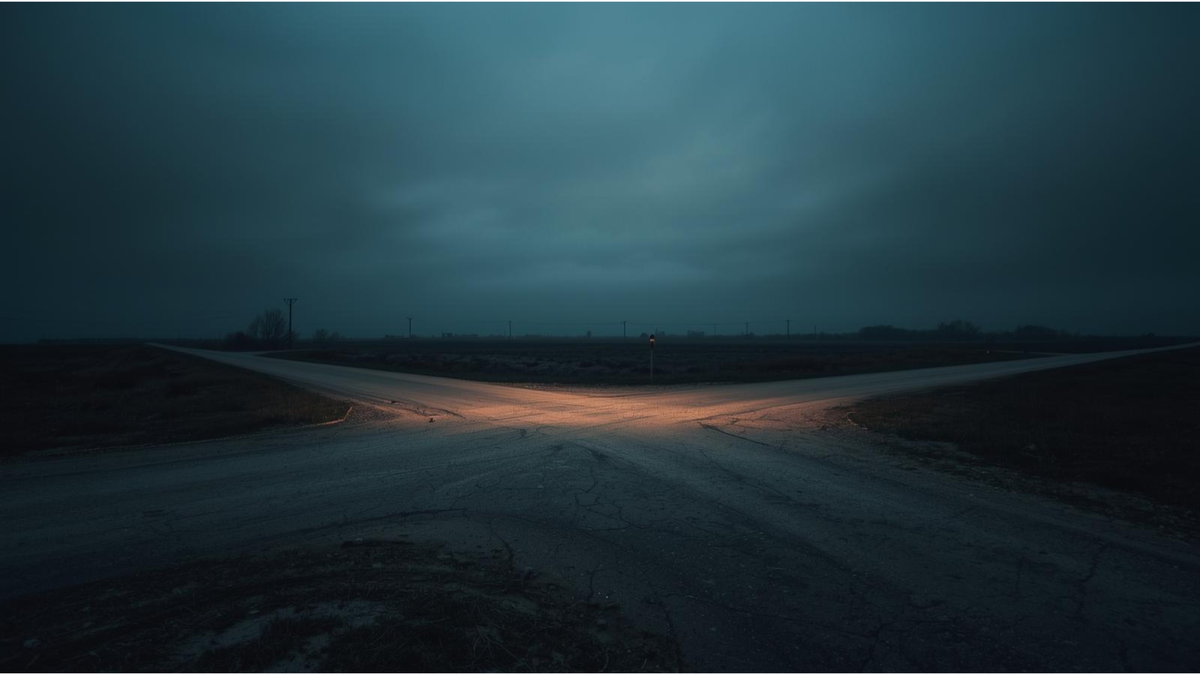
Lately, I’ve found myself at a crossroads.
Not a love-triangle like I watched in Eternity last week, or the harrowing, musically-soaked moments of fate that defined Song Sung Blue, but something else that feels just as unsettling.
Because both stories forced me to confront a question I've avoided for a while:
What choice do I make when there isn't a clear best option?
Yeah, it’s been a week.
The Balkan Storm and I have been on a bit of a streak lately, watching two of my favorite Marvel stars in very different projects. Last week we saw, Elizabeth Olsen in Eternity, playing a woman in the afterlife forced to choose between the two great loves of her life.
The whole premise is a bit soft and almost gentle until it finally isn’t, which makes the eventual later impact so much unexpectedly better. I had to laugh because it took my husband three-fourths of the movie to realize who she was.
“Wait, isn’t that…yeah, that’s the witch!” he said, squinting. “Yes, dear. The Scarlet Witch. From the MCU.” I replied with the satisfied smirk of someone who knew he knew that character because of me.
I won’t spoil the film since it’s still new, but it was the first time a movie made me reflect on eternity as a choice instead of a celestial reward. Who we are, what we choose, and what those choices cost us in the end.
A few days ago, I got to watch the film I’d been dying to see: Song Sung Blue.
Wow.
I missed my chance to troll Hugh Jackman when he was in Wisconsin before Christmas to promote the movie. He wasn’t far from where I live. I considered greeting him with a WELCOME RYAN REYNOLDS! sign, but I’m too old and too smart to stand out in the cold for that long, even for Hugh Jackman.
Still, I was excited. A biographical musical (my weakness) based on a real tribute band from Wisconsin had my full attention from the jump. As usual, the film took some creative license, but the movie captured us completely.
Jackman and Kate Hudson told the story with an immersive intensity that made the high points feel achingly justified and the lows truly unfair.
I believe this film might be Kate Hudson’s best work yet. Her singing voice was incredible, and she nailed not only the accent up here but that very vulnerable portrayal of mental health struggles, especially post-trauma.
Despite the artistic license, the film took us on a very relatable journey through marriage, a blended family, trauma, and the struggle to keep the show ‘going on’ while an invisible clock ticks the whole time.
God, I really felt that.
Both movies, in their own way, posed the same questions to me: What do you choose, knowing either decision is going to hurt in some way? And how long can you keep going before uncertainty starts to hollow you out?
I’ve begun to question how I think about my value on some days. There’s nothing inherently wrong with being helpful, accessible, available, or flexible. Those traits are among many that keep families and functions together.
My issue is when that usefulness starts to feel like my primary measure of worth. Which, to be clear, is on me, not anyone else.
I’ve been strongly, strongly supported and encouraged by those closest to me. I also know how it feels when stress and anxiety strip away nuance and make even the most well-intentioned words feel demoralizing in your ears.
Kids don’t always know better, and adults can believe they understand while still not quite getting it.
So I’m figuring out how to self-course-correct and honor my commitments, my family, and responsibility without feeling like someone I’ve never wanted to be again: a utility.
What I felt most was the insistence of Jackman’s character. He wanted to entertain people. He wanted to sing and give people a moment when life didn’t feel so damn hard, even if only for a few moments.
But over time, it became meaningless without his wife by his side.
And I felt that deeply because even when you love what you do, it isn’t the same when the people you love feel far away.
Even though the medium is different for me, the instinct is still the same. All I’ve ever wanted to do is tell stories that connect, that make someone feel related to, a little less alone, again, if even for a few moments.
Instead of a stage, I have a platform. And instead of a crowd, I have an analytics dashboard that tells me people are there, even if I can’t hear them for myself.
Writing like this can sometimes feel extremely solitary. You send the work out and trust that it goes somewhere. You wonder if connection even matters when you can’t yet feel it coming back.
You stand at the crossroads, not willing to turn back, but not sure if or how you should keep going.
Some days, that’s just where you are.
If you'd like to support the work, here's where to do it.
Related Reads:
- Don't Let the Bastards Win - A movie about grandmothers in a restaurant reflects a much bigger story about effort, grit, and creating your legacy.
- The Writings on the Wall - Family drama, legal wrangling, and the moment you realize the end is already here.
- Somewhere in Time - Escapism, timing, and the ache of not knowing if you're simply running in place.
Heather Papovich is the voice behind Unfinished Business, a weekly essay series where real life meets pop culture, and how to get through both without (mostly) losing it.